
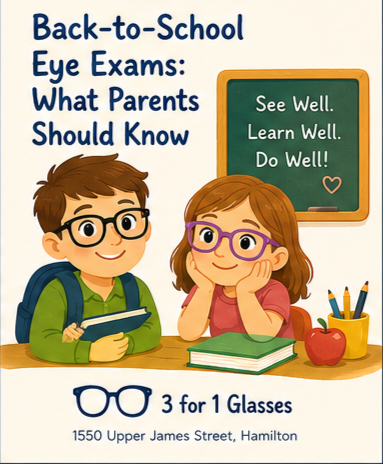
Back-to-School Eye Exams: What Parents Should Know

New shoes? Check. Backpack? Check. Lunch bag that will somehow disappear before Thanksgiving? Probably.
There is one more item families should consider adding to the back-to-school list: an eye exam.
Clear and comfortable vision plays an important role in reading, writing, using a computer, participating in sports and following lessons at the front of the classroom. Because children may not realize their vision is different from anyone else’s, they do not always tell a parent when something is wrong.
Children Do Not Always Know They Have a Vision Problem
A child who has always seen the board as blurry may assume everyone sees it that way. Another child may be able to read an eye chart but still have difficulty focusing at close distances or getting both eyes to work comfortably together.
That is one reason a comprehensive eye exam is different from a basic school or vision screening. A screening may identify certain concerns, but it does not replace a full assessment of eye health and visual function.
Signs Your Child May Be Struggling to See
Watch for behaviours such as:
Squinting
Sitting unusually close to the television
Holding books, tablets or phones very close
Covering or closing one eye
Tilting or turning the head to look at something
Frequent eye rubbing
Excessive blinking
Headaches after reading or schoolwork
Complaints of blurry or double vision
Losing their place while reading
Avoiding reading or other close work
Difficulty seeing the board
Unusual clumsiness or problems judging distance
Red, watery, itchy or burning eyes
These signs do not prove that a child needs glasses, but they are good reasons to arrange an eye exam.
Vision Can Affect School Performance
Many classroom activities depend heavily on vision. A student regularly switches between looking at a worksheet, a computer screen and the front of the classroom.
When seeing clearly requires too much effort, a child may lose concentration, work more slowly or avoid certain activities. A vision problem can sometimes look like a problem with motivation or attention.
Glasses will not solve every learning difficulty, of course. They are eyewear, not wizardry. However, correcting a vision problem can remove an unnecessary barrier and help a child participate more comfortably.
Do Children Need an Exam Every Year?
The Canadian Association of Optometrists recommends that school-aged children between six and 19 receive a comprehensive eye exam annually. Children with specific conditions or risk factors may need to be seen more frequently based on professional advice.
Yearly exams matter because a child’s eyes and prescription can change as they grow.
Choosing Glasses for School
Children’s glasses need to survive real life—not merely look good while sitting neatly in a case.
Consider:
A secure and comfortable frame fit
Durable frame materials
Impact-resistant lens options
Proper bridge fit
Temples that hold the frame in position
A style the child feels confident wearing
A backup pair when practical
Allowing children to participate in choosing their frames can make them more willing to wear and care for their glasses.
Create Better Screen Habits
Schoolwork increasingly involves digital devices. Encourage children to follow the 20-20-20 rule by looking approximately 20 feet away for 20 seconds after every 20 minutes of close screen use.
Outdoor play, sensible screen breaks, appropriate lighting and a comfortable working distance can also support visual comfort.
Start the School Year Clearly
An eye exam can help identify concerns before they begin interfering with the school year.
At 3 for 1 Glasses, we help Hamilton families choose properly fitted, durable eyewear that works for school, sports and everyday life. We also offer a children’s eyewear special for eligible ages; contact the store for current details and conditions.
Visit us at 1550 Upper James Street in Hamilton, or contact us to ask about eye-exam availability and children’s eyewear options.


Comments