
How to Read Your Eyeglass Prescription (A Plain-English Guide)

You just finished your eye exam, and the optometrist hands you a small slip of paper covered in letters and numbers. OD, OS, SPH, CYL, AXIS. Unless someone explains it, that slip might as well be written in another language.
You are not meant to need a medical degree to understand your own vision. This guide breaks down exactly what each part of your prescription means, in plain English, so you can read it with confidence whether you are picking out new frames, ordering glasses online, or just curious what your eyes are actually doing.
We will walk through a real example line by line, so by the end you will be able to read any prescription handed to you.

The Basic Layout: OD, OS, and OU
Before the numbers mean anything, you need to know which eye they belong to. Most prescriptions use Latin abbreviations left over from older medical charting conventions:
OD (Oculus Dexter) means right eye
OS (Oculus Sinister) means left eye
OU (Oculus Uterque) means both eyes
Your prescription is almost always laid out as a table with OD on top and OS below (or side by side), each with its own row of numbers. This matters because your two eyes rarely need the exact same correction. One is often slightly stronger or weaker than the other, which is completely normal.
Some newer prescriptions use RE (right eye) and LE (left eye) instead of the Latin abbreviations, especially from optometrists who prefer plain English. The numbers underneath mean the same thing either way.
What Each Number Means
SPH (Sphere)
This is the main correction for your overall vision, measured in diopters. A minus sign (like -2.50) means you are nearsighted (myopic), and objects far away look blurry. A plus sign (like +1.75) means you are farsighted (hyperopic), and close-up objects are harder to focus on. The higher the number, further from zero, the stronger the correction.
CYL and AXIS (Astigmatism Correction)
If you have astigmatism, your prescription will include a CYL (cylinder) number and an AXIS number together. CYL measures how much correction is needed for astigmatism, while AXIS (written as a number between 1 and 180) tells the lens maker which direction, in degrees, that correction needs to be oriented. These two numbers only make sense as a pair. If your prescription has no CYL listed, it means you do not have astigmatism, or it is too mild to require correction.
ADD (Addition)
This number only appears if you need bifocals, progressives, or reading glasses. It is the extra magnifying power added to the bottom portion of the lens for close-up tasks like reading. ADD is always a plus number and is the same for both eyes, even if your SPH numbers are different.
PD (Pupillary Distance)
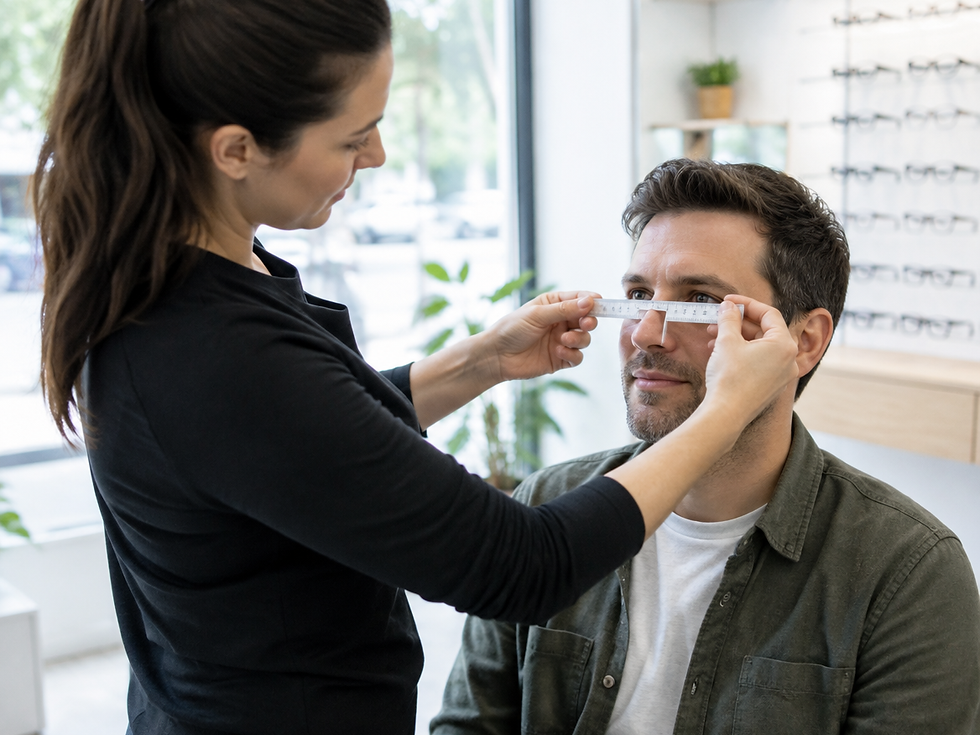
PD is the distance between the centers of your pupils, measured in millimeters. This number is critical for getting your lenses positioned correctly in the frame, but many optometrists do not include it on the written prescription because it is considered a fitting measurement rather than a medical one. If your prescription does not list a PD, you will need to have it measured separately, which most optical stores do in person at no charge.
A Real Example, Broken Down Line by Line
Here is a sample prescription, similar to what you might be handed after an exam:
Eye | SPH | CYL | AXIS | ADD | PD |
OD | -2.25 | -0.75 | 180 | +1.50 | 31.5 |
OS | -2.00 | -0.50 | 175 | +1.50 | 31.5 |
Reading the OD row: this person is moderately nearsighted (-2.25), has a mild amount of astigmatism (-0.75) oriented at 180 degrees, and needs an additional +1.50 of magnification for reading, likely for progressive or bifocal lenses. The OS row is nearly identical but slightly less nearsighted, which is common. Both eyes share the same PD measurement in this case, though they do not always match exactly.
If this same person's prescription had no CYL or AXIS listed at all, it would simply mean no astigmatism correction is needed, and the row would just show SPH and ADD.
Common Mistakes People Make Reading Their Prescription
Assuming a bigger number is always worse. A -6.00 is a stronger correction than a -2.00, but neither is inherently a health concern on its own. The number reflects how much correction you need, not how damaged your vision is.
Mixing up your glasses prescription with your contacts prescription. These are not interchangeable. A contact lens prescription includes additional measurements, like base curve and lens diameter, that have nothing to do with glasses, and the SPH numbers themselves are often adjusted slightly differently for contacts versus glasses.
Ignoring a missing PD and assuming it does not matter. Ordering glasses without an accurate PD is one of the most common reasons new glasses feel "off," even when the rest of the prescription is correct.
Assuming an old prescription is close enough. Even a small, outdated SPH or CYL number can cause headaches and eye strain over time, especially if your prescription has shifted since your last exam.
Why Your Prescription Alone Doesn't Guarantee the Right Glasses
Your prescription tells a lab exactly how to grind your lenses. It does not tell anyone how those lenses need to sit in front of your eyes, how your frame fits your face, or which lens material and coatings will actually serve your lifestyle. Two people with the identical prescription can end up with very different results depending on frame fit, PD accuracy, and lens choice.
This is really the difference between ordering glasses and being properly fitted for them. An accurate prescription is step one. Getting your PD measured in person, choosing a frame that fits your face shape, and picking the right lens type for how you actually use your eyes all day is what makes the difference between glasses that work and glasses that just technically match your prescription.
At 3 for 1 Glasses, we measure PD and walk through frame fit with every customer at no extra charge, whether you are picking up your first pair or your fifth.

FAQs
How long is an eyeglass prescription valid?
Most eyeglass prescriptions in Ontario are valid for one to two years, depending on your age and eye health. Children's prescriptions are typically reviewed more often since their vision changes faster.
Can I use my contacts prescription to order glasses?
No. Contact lens prescriptions include measurements specific to the lens sitting directly on your eye and are not a substitute for a glasses prescription, even though they come from the same exam.
What if my prescription doesn't list a PD?
This is common and not a problem. Most optical stores, including ours, will measure it for you in person at no cost before your glasses are ordered.
Do I need a new prescription for every pair of glasses I buy?
You need a current, valid prescription, but you can use the same one to order multiple pairs within its valid period, which is exactly how a multi-pair package works.
Why does one eye have different numbers than the other?
This is completely normal. Most people have some degree of difference between their two eyes, and your prescription is written separately for each one for exactly that reason.
Not Sure What Your Prescription Means for You?
If you are holding a prescription and still not sure what it means for your next pair of glasses, bring it in. Our team will walk you through every number, measure your PD in person at no charge, and help you find frames that actually fit.
Book your eye exam online at 3for1glasseshamilton.com/book-your-exam, or stop by our Upper James St location on Hamilton Mountain and shop our packages in person, starting with three pairs for the price of one.
Visit 3 for 1 Glasses - Hamilton
1550 Upper James St, Hamilton, ON L9B 2L6
Phone: 905-383-1467


Comments